





Sustainable energy transition in the MENA region 2025 is the central narrative framing CARE MENA 2025 — a landmark forum dedicated to climate action, renewable energy, decarbonisation, ESG standards and green innovation. As one of the most influential sustainability events in the region, CARE MENA 2025 functions simultaneously as a conference, policy lab, investment marketplace and global innovation showcase.
The summit’s positioning within the broader climate landscape is clear: while many global forums focus on ambition, CARE focuses on implementation. Its structure — from ministerial sessions to investor roundtables, from climate dialogues to the ClimateTech World Cup — reflects a transition from strategy to operational execution.
Definition and Context
Definition: The sustainable energy transition in the MENA region 2025 refers to the systemic transformation of energy systems away from fossil fuel dependency toward renewable, low-carbon and circular energy models. It includes renewable power generation, industrial decarbonisation, green hydrogen, energy storage, smart grids, nature-based solutions and climate-resilient infrastructure.
The context provided by the CARE MENA Media Kit illustrates a region undergoing a structural shift. Despite being historically associated with hydrocarbons, the Middle East has become one of the fastest-growing hubs for renewable energy deployment, sustainable finance and climate policy innovation. Ambitious national roadmaps — such as the UAE Net Zero 2050 Strategy and Saudi Arabia’s Circular Carbon Economy model — are reorienting policy frameworks, investment flows and industry behaviour.
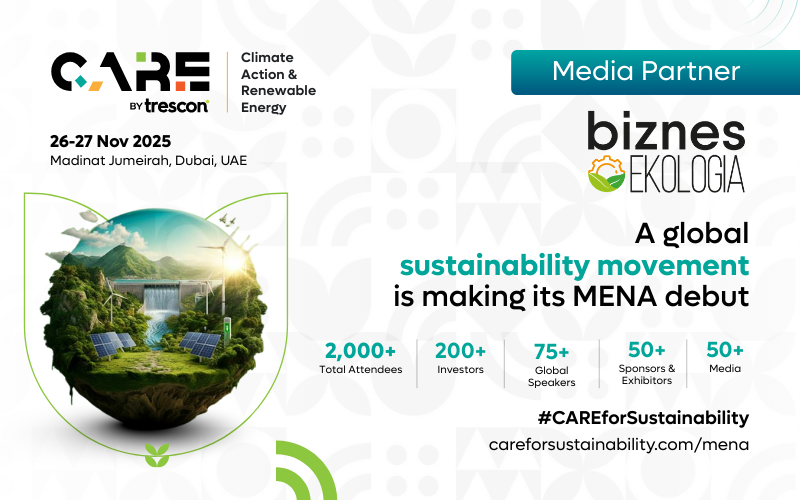
CARE MENA 2025 builds on this momentum by bringing together global institutions, policy-makers, investors, scientists and corporate leaders. With over 2,000 participants, 75+ speakers and 50+ sponsors, the event functions as a platform for real-world decisions, not just discussion. The emphasis is on tangible outcomes: dealmaking, project acceleration, ESG benchmarking and cross-sector collaboration.
The next section illustrates how CARE MENA translates these broad goals into actionable examples across policy, technology and finance.
Examples and Case Studies
1. Climate Policy and Governance Innovation
Example: Senior officials from regional climate ministries and councils featured in the CARE MENA programme reflect the central role of government in steering the transition. These leaders drive national climate policies, NDC (Nationally Determined Contributions) commitments and regulatory frameworks to foster renewable energy, electrification and environmental protection.
Source: CARE MENA Media Kit (2025) — profiles of government and policy speakers.
2. Corporate Sustainability Leadership
Example: Executives from finance, maritime, retail, infrastructure and industrial sectors highlight how corporate sustainability has moved from compliance to core strategy. Green supply chains, energy efficiency, circularity and ESG reporting are now embedded into business models.
Source: CARE MENA Media Kit — global speakers from sustainability, ESG and corporate governance roles.
3. Green Finance and Impact Investing
Example: One of the strongest themes in the Media Kit concerns sustainable finance — green bonds, climate funds, impact investment and blended finance. These instruments guide capital toward climate-resilient infrastructure, renewable projects and transition technologies.
Source: CARE MENA Media Kit — financial institutions and impact investment specialists.
4. ClimateTech World Cup
Example: The ClimateTech World Cup provides a global platform for start-ups in areas such as carbon capture, water innovation, sustainable materials, energy storage and circular economy solutions. The 10 finalists present technologies capable of delivering measurable climate impact.
Source: CARE MENA Media Kit — ClimateTech World Cup description.
Analysis of Challenges and Trends
The sustainable energy transition in the MENA region 2025 is shaped by several strategic dynamics that determine the pace and impact of climate progress. CARE MENA 2025 offers insight into these dynamics through its agenda, speaker lineup and thematic structure.
1. Scaling Renewable Energy Deployment
The MENA region has some of the highest solar irradiance levels in the world, making large-scale solar energy economically attractive. Countries such as the UAE and Saudi Arabia lead global rankings for utility-scale solar projects. Wind energy potential is also significant in coastal zones and mountainous regions.
The challenge lies not in resource availability but in grid flexibility, financing models, cross-border exchange and storage capacity. CARE MENA sessions address how policy reforms can unlock additional gigawatts of renewable deployment while maintaining grid stability.
2. Industrial Decarbonisation
Industrial sectors — steel, cement, petrochemicals — account for a substantial share of regional emissions. New models of industrial decarbonisation involve carbon capture and storage (CCS), process electrification, hydrogen-based heating and materials innovation. The summit includes examples of pilot projects and emerging technologies that can reduce heavy-industry footprints.
3. Green Hydrogen and the New Energy Economy
Green hydrogen is seen as a pivotal opportunity for the region. With abundant renewable resources, MENA countries aim to become global leaders in hydrogen production and export. Several CARE speakers represent entities involved in hydrogen roadmaps, electrolysis technologies and green ammonia projects.
4. Sustainable Mobility and Transportation
MENA cities are adopting electric vehicles, charging networks, sustainable public transport and smart mobility systems. CARE MENA discusses battery innovation, recycling and circularity — critical for closing the lifecycle loop of EV adoption.
5. Climate Risk, Adaptation and Nature-Based Solutions
Alongside mitigation, adaptation is a growing priority. Rising temperatures, water scarcity and extreme weather demand new strategies for climate resilience. Nature-based solutions — mangrove restoration, regenerative agriculture, coastal protection — play a strategic role in regional sustainability planning.
6. ESG Integration and Corporate Accountability
ESG frameworks are expanding across finance, insurance, retail and construction. CARE MENA underscores the importance of standardised metrics, transparent reporting and integrated risk assessment. As global regulatory frameworks evolve, MENA corporations increasingly align with international standards.
7. The Role of Innovation Ecosystems
The ClimateTech World Cup and the CARE Launchpad illustrate how start-ups, accelerators, research institutions and impact investors collaborate to scale solutions. Innovation ecosystems are becoming essential to driving region-wide transformation.
Transitioning from challenges to outcomes, the next section explores the strategic implications of these trends for business, policy and investment communities.
Conclusions and Recommendations
Conclusion: CARE MENA 2025 positions the region at the forefront of the sustainable energy transition in the MENA region 2025. Its comprehensive agenda — from renewable deployment to green finance, from industrial decarbonisation to ESG integration — highlights a region ready to redefine global climate leadership. The summit moves beyond rhetoric, presenting actionable frameworks for transforming energy systems, accelerating innovation and building climate-resilient economies.
Recommendation: Organisations operating in the region should focus on enhancing climate governance, identifying decarbonisation pathways, and aligning investments with sustainable finance frameworks. Governments should prioritise regulatory stability, cross-border collaboration and incentives for private-sector innovation. Investors should consider high-impact sectors such as green hydrogen, circular materials, water innovation and climate-resilient infrastructure.
Download Media Kit
Download: CARE MENA Media Kit 2025 (PDF)